The agentic state
14 Oct 2026
Working on dovevannoinostrisoldi.com and italiaaperta.it, I have dealt with two sides of the relationship with the State: understanding how public resources are used, and helping people use public services.
The first project makes public data searchable while keeping the link to the sources. In the second, Pino helps people find their way through procedures and official pages.
With SuperPino, also from italiaaperta.it, we have started working on execution as well: the system prepares a report for the municipality, finds the recipient and, where possible, sends it after the user’s confirmation and a human check. It is a narrow activity, an experiment, but it already contains useful pieces: a task, tools to carry it out, authorizations, and controls before the action.
I want to extend this line of reasoning to how institutions work.
The proposal is to gradually entrust to agentic systems a large share of the operational work in the relationships between citizens and administrations, between public offices, and between the different institutions of the State. People would still set goals, make decisions, and answer for the results.
By agent I mean a system able to carry out a task using authorized data and tools: prepare a file, transmit it, check a reply, continue when the conditions are met, or ask a person to step in.
The citizen assigns a request and can follow its execution
Take a move as an example. The citizen says they are changing home and asks for help with the related obligations. The system finds those that apply to their situation, retrieves accessible data, and asks for what is missing.
Before proceeding, it shows the requests to send, the recipients, and any costs. The citizen can correct them, authorize only some operations, or stop.
After submission, the agent keeps the receipts and follows the files. If an office asks for more information, it collects the request, explains what is missing, and prepares the reply. The citizen sees which steps are done, which are waiting, and which need a decision from them.
The same model could apply to starting a business or requesting a municipal service. Each path would have its own rules, but the relationship with the administration would become recognizable: I assign a task, I check what is being done, I intervene when needed.
For people who still use the counter, this capability should be available through the operator. The service must also work for those who do not want to interact directly with a digital assistant. But it is obvious we will move in this direction with the generational shift coming over the next 10 to 15 years.
Offices exchange work that is already usable
The citizen’s path depends on what happens inside the offices. This is where I see an important part of the proposal.
Imagine a municipal file that needs a technical opinion from another public body. The office agent prepares the request with the necessary documents, sends it through an authorized channel, and records receipt. The receiving body’s system checks that the file is complete and assigns it to the person in charge.
If an attachment is missing, the request for more material goes back to the office that can provide it. When the opinion arrives, it is linked to the file and the procedure continues under the established rules.
This requires systems that can recognize the same file and the meaning of the documents exchanged. And above all, it requires that people can see what is happening in another body.
Every step should therefore have a verifiable outcome. If the flow stops, it must be clear where, why, and who can unlock it.
Government and ministries coordinate the execution of decisions
The agentic state should also cover the work between the Presidency of the Council and the ministries, and the work between directorates inside the same ministry.
Consider a school renovation program. For this example, imagine that delivery requires technical criteria, financial checks, contributions from several administrations, and later communications to local bodies.
Once responsibilities are defined, an agentic system could open the necessary activities, assign them to the indicated offices, and follow the deadlines. Each office’s agent would collect the documents, prepare its contribution, and submit it to the person in charge before formal transmission.
Coordination would then have an up-to-date picture of the work: which contributions have arrived, which are missing, which comments have been incorporated, and which remain open.
If two ministries are working on different versions of the same text, the system flags the differences. If a step depends on a decision that has not yet been taken, it shows that dependency. If disagreement appears, it prepares the points on which those responsible must decide.
The Presidency of the Council could use this picture to follow the execution of decisions and ask for precise interventions. Each ministry would keep control of its own activities and of access to its own data.
The Chamber and the Senate get continuous support for parliamentary work
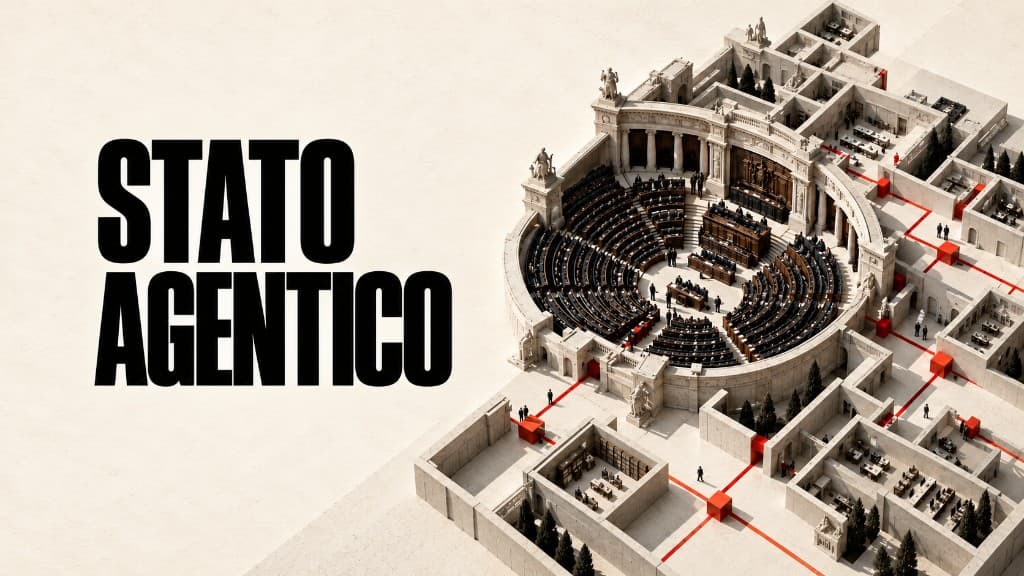
In Parliament I would start from managing the texts and preparing the work.
For every bill, agents could keep the comparison between versions, link amendments to the affected articles, collect legal references, and update the dossiers for the committees. Every change would have a source and a precise place in the process.
An MP or an official could ask which parts of the text changed after a given step and get a documented comparison. A committee could receive an updated file for the sitting, with the contributions received and the questions still to examine.
The competent offices would check these materials. Financial assessments, legal interpretations, and political choices would still need recognizable responsibility: the system should make sources, assumptions, and uncertain points explicit.
The Chamber and the Senate should govern their own systems autonomously. Where documents are public, part of the same functions could let citizens follow the examination of a law with more precision.
Spending control follows execution
The work on DoveVannoINostriSoldi.com also suggests an application to administrative control.
For a public intervention, an agent could collect the available acts and compare appropriations, commitments, and payments, keeping these quantities distinct. It could follow deadlines, detect missing documents, and flag discrepancies to check.
The useful result would be a circumstantial alert: which figure changed, against which forecast, in which document, and with which limits of comparison.
The responsible office would have the material to dig deeper. Publishable information could also feed tools open to citizens, without exposing reserved data.
Supervision has to work in practice
Writing “supervised by humans” still leaves many questions open.
Who checks? What do they see? How much time do they have? Can they cancel an operation?
For every automated activity I would define a responsible person — also for liability — the allowed operations, and the conditions that require stopping. The record of the work should make it possible to reconstruct the data consulted, the documents produced, and the actions taken.
Supervision would take different forms according to risk. A repetitive and reversible activity could run within preset limits, with periodic checks. A decision that affects a person’s rights would require an adequate review and an accessible path to contest it.
Putting an official in front of hundreds of requests to approve quickly would produce weak control. The verification load has to be measured too.
A transformation that will take years
Describing an agentic state is much easier than building one. For a change of this scale I would count on decades of work. It would mean intervening on IT systems, procedures, people’s skills, and the rules that govern public work. During that path the State would still have to function, with new services and existing structures living side by side.
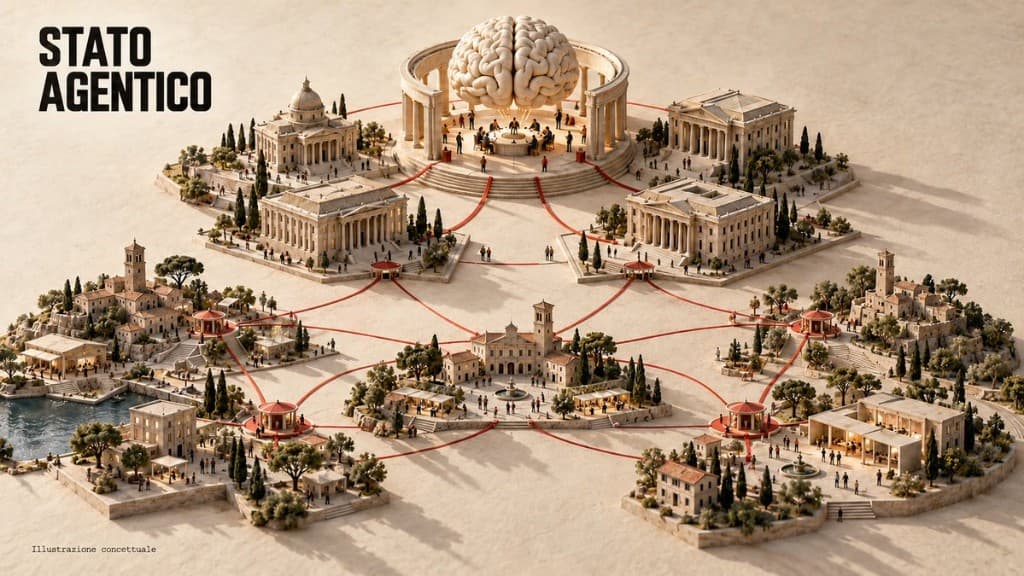
The vision I want to reach is that of a large coordination brain, able to follow the execution of public decisions across the administrations involved. A central system would receive the goals approved by the competent authorities, prepare the activities to carry out, and follow their progress. The agents of individual offices would execute authorized tasks, reporting results, delays, and problems. Information should flow in both directions: whoever coordinates must know what happens during execution.
The reference for this function is the President of the Council, who directs the general policy of the Government and coordinates the work of the ministers. In the model I imagine, the agentic system would give this function continuous operational capacity, under the responsibility of the people who hold the institutional roles. Ministers and their offices would keep their respective responsibilities.
The link with Regions and Municipalities needs a distinction: they are autonomous bodies, with their own competences, so treating them as mere offices subordinate to ministries would be wrong — though that does not mean it could never change.
Coordination should extend through agreements, shared procedures, and exchanges between systems, respecting the responsibilities of each body. The same applies to Provinces and Metropolitan Cities. The Chamber and the Senate would have their own systems in support of their functions.
Imagine a public program involving a ministry, several Regions, and many Municipalities.
The central system could follow the program as a whole, while the agents of the administrations involved would manage the activities under their competence.
The first expected effect would be speed. Time spent copying information, searching for documents, checking the status of files, and chasing replies could fall. A completed activity could start the next step as soon as the required conditions are met. The gain should be measured on the real duration of procedures, including the work needed to check and correct the agents.
The second would be transparency, internal and external. Inside the administration, every person in charge could see which activities are stuck, for how long, and why. Outside, the citizen could follow their own file and know which office is responsible for the current step. On the delivery of public programs, progress, spending, and gaps could be published, with verifiable data and respect for reserved information.
This transparency should be designed in from the start. Every relevant operation should leave a trace that those entitled to see it can consult.
I want the same system used to move the work forward to also make it reconstructible: which decision was taken, how it was executed, where it stopped, and who must intervene.